Let's go! Here come the vectors. Get the introduction to Adobe Illustrator CC and get a professional start in graphic design and illustration!
I'm delighted to welcome you to my very first Adobe Illustrator basics training course.
In this video there is no tutorial yet, but first a short introduction on my part and a rough overview of the entire training.
Have fun with it. :-)
In this first "real" video of the basic training you will get an overview of the user interface of Adobe Illustrator CC.
This video is about the topic "Workspaces in Illustrator". We take a basic look at what a workspace is and how you can create and save your own workspace.
As a conclusion to chapter 1, this video is about some small (but still useful) features in the preferences of Adobe Illustrator.
In the first part of Chapter 2 of the big Illustrator basics training course, you will get a brief overview of the various areas of application for Adobe Illustrator.
This video shows the basic difference between vectors and pixels.
Before we finally get started with the practical videos in Chapter 3, I would like to address the question "What are paths in Illustrator?" in the last theoretical section.
In the first part of chapter 3, you will learn all about "Artboards in Illustrator".
In this video you will get a short introduction to the topic of "color management". More specifically, it's about when you should choose the CYMK or RGB color space. I also show you where the dangers lurk when choosing a color space.
What are rulers and the so-called zero point good for? These questions are answered in this video.
Guides can simplify your work in Illustrator many times over. In this video, you will learn about the different types of "guides" and which settings can be helpful.
The best artwork is useless if you don't save it correctly. This video is about different ways to save documents correctly in Illustrator.
We have now reached chapter 4 of the great basic training on Adobe Illustrator. This video is about the "selection tools" of Illustrator.
This video gives you an introduction to how Illustrator's "pen tool" works.
In this short video you will learn a few details about Illustrator's "line tool".
This video explains Illustrator's "Text tool".
Since you often have to create shapes in Illustrator, here is a video about the various "shape tools" in Illustrator.
You can also do a lot with the "brush tool" in Illustrator. This video gives you a brief overview of these functions.
Creating shapes easily and graphically is not possible? Then you probably haven't gotten to know Illustrator's "Shaper tool" yet. :-) This video gives you a brief overview of this small but powerful tool.
Have you ever used the "eraser tool" in Illustrator? If not, you can find out more about this little helper in this short video. :-)
It is often necessary to rotate or mirror created objects or shapes in a certain direction. You will learn about the right tools for these tasks in this video. :-)
In this video, I will show you two tools that are probably rarely used, but can be very useful in certain situations. I'm talking about Illustrator's "Scale tool" and the "Bend tool".
Liquefying only works in Photoshop? Far from it ... :-) Illustrator also has some tools for deforming and liquefying your vector graphics.
This video is about the "free-transform tool" of Adobe Illustrator.
Creating shapes can be so easy ... Don't believe me? Then take a look at this video about the "shape creation tool". :-)
Illustrator also offers the option of perspective distortion. You can find out more in this video. :-)
If you deal with the topic of "graphic design", then sooner or later you will not be able to avoid the topic of "gradients". This video provides a brief introduction to Illustrator's "gradient tool".
This video is about the "pipette" and the "measuring tool".
The "Adjust tool" offers many possibilities to get creative. You can find some suggestions for using this tool in this video. :-)
This short video is about two absolute "basic tools" that you need all the time, and not just in Illustrator.
Chapter 5 of the great basic training course on Adobe Illustrator is now just around the corner. This chapter is all about the most important "tool palettes" in Illustrator.
In this video we take a look at the "Layers palette". :-)
The "Appearance palette" in Illustrator offers a wide range of options. This video gives you a brief overview.
In this video, color comes into play. Here you will learn the basics about the "Color Palette" and the "Swatches Palette" of Adobe Illustrator.
This video is about the basic "typography palettes" of Illustrator.
In this video you will learn about the functions of the "Paragraph and character formats".
This video shows you how the "symbol palette" works in Illustrator.
You often have to align objects or graphics very precisely on a layout or workspace. And in this video I show you how easy it is to accomplish such "alignment tasks". :-)
The "Pathfinder" is an extremely important part of Adobe Illustrator. This video gives you a brief overview of its areas of application.
It can often be helpful to merge two or more paths. You can find out how this works in this video. :-)
Adobe Illustrator offers the option of running text along a path. You can find out more about this topic in the video.
Anyone who deals with Adobe Illustrator and the topic of graphic design will sooner or later stumble across the term "convert fonts to paths". Some tips and explanations on this topic can be found in this video.
This video is about the Illustrator dialog "Move path". Have fun watching. :-)
Why is the Illustrator dialog "Convert" sometimes so important? You can find the answer in this video.
Clipping masks are a powerful tool in Illustrator. Watch this video to find out how you can even use them to crop images. :-)
You often have to transform, move or rotate an object or several objects evenly over and over again. You can find out how to master such tasks in this video. :-)
Adobe Illustrator already has a powerful "pattern generator" on board. This video gives you a brief overview of these pattern functions.
In this video, we will create a 3D object directly in Illustrator from a 2D vector graphic.
Adjusting objects in perspective is no longer a task that can only be solved in Photoshop. With the "Perspective Grid", this can also be done directly with Adobe Illustrator.
In the Adobe Illustrator effects gallery, there are "Illustrator effects" and "Photoshop effects". But what's the difference? You'll get the answer in this video. :-)
Adobe Illustrator's "Image Tracer" is a truly powerful tool. This video gives you a brief overview of how it works.
In this tutorial, we will be looking at the topic of "optical illusions". I have prepared four optical illusions for you and we will now create them step by step together in Adobe Illustrator.
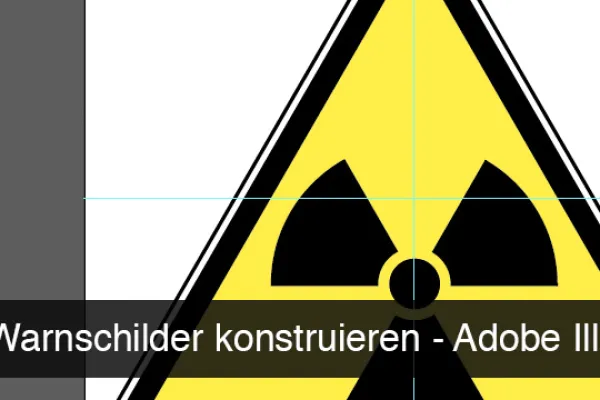
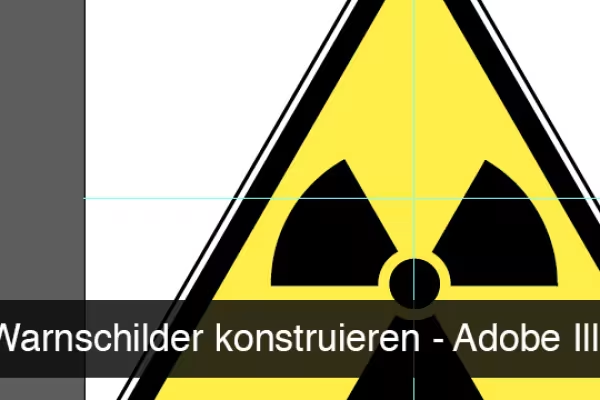
In this tutorial, you will learn how to design warning signs or danger signs in Illustrator. First, we will look together at how to create the basic structure for such a warning sign, and so that you can then fill your basic structure with the appropriate content, we will build a "radioactive symbol" and a "biohazard sign" in Illustrator. Among other things, you will learn how to use the shape creation tool.
Here you will learn how to create a beautiful gold effect. I will also show you how to create your own color libraries so that you can use the gold colors that we will create later at any time. Finally, as a little extra, we'll take a look at how you can turn a 2D text into a 3D realization.
So, enough talk now. Let's get straight to it ...
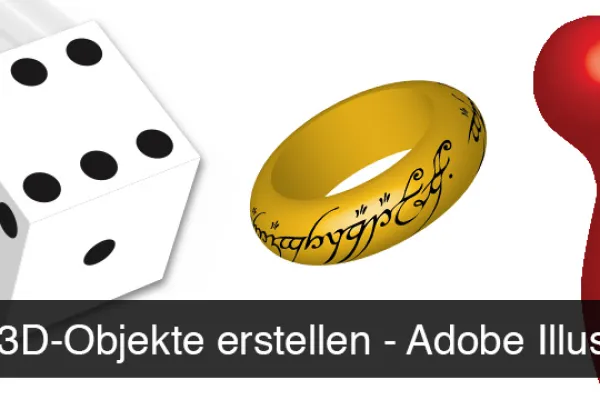
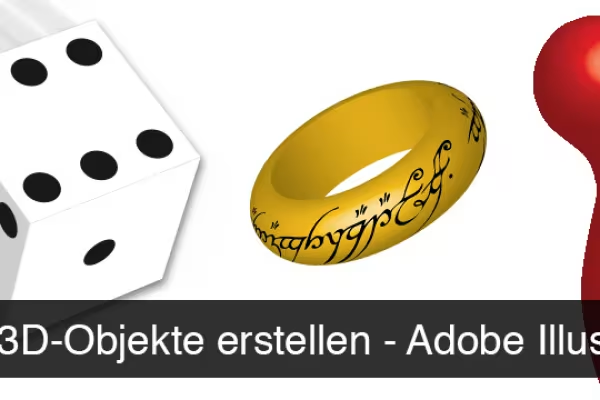
Did you know that Illustrator also offers 3D functions? If not, this tutorial is just right for you. Together we will dive step by step into the 3D functions of Adobe Illustrator and construct three different 3D objects. These include a game figure (as we know it from "Mensch ärgere dich nicht"), a fully textured game cube and, as a small highlight, we will also build "the one ring" from "The Lord of the Rings".
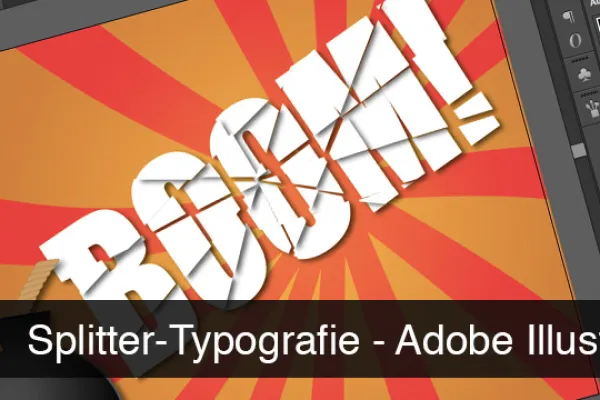
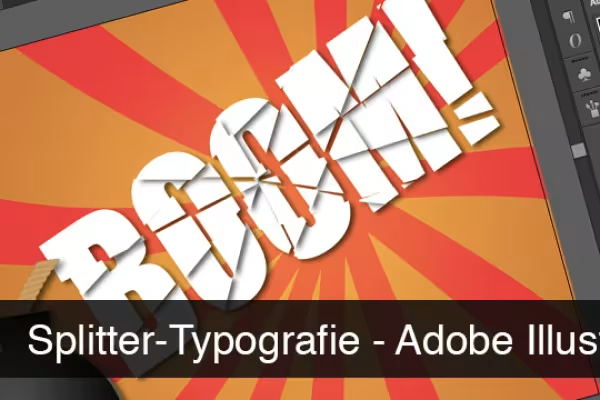
Here we will look together at how to create such a beautifully splintered text in Illustrator. We'll also create a suitable background and at the end we'll round off the whole thing with a kind of comic bomb (included in the working files).
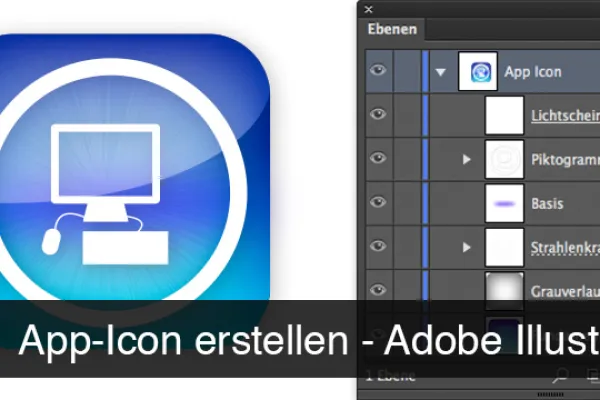
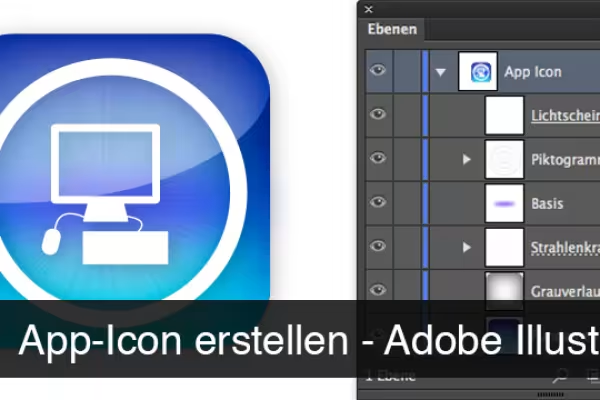
In this tutorial you will learn how to create a beautiful app icon in Illustrator. We will implement an iOS 5-style app icon step by step. If you are now thinking that iOS 5 is now outdated, you are of course absolutely right. However, the icon design back then was somewhat more complex than the current design. Therefore, after this tutorial, it will probably be easy for you to create icons in the current design.
In this tutorial, you will get to know the Appearance palette in Illustrator from a whole new perspective. Together we will create a button step by step using only the Appearance palette. Have fun with the tutorial.
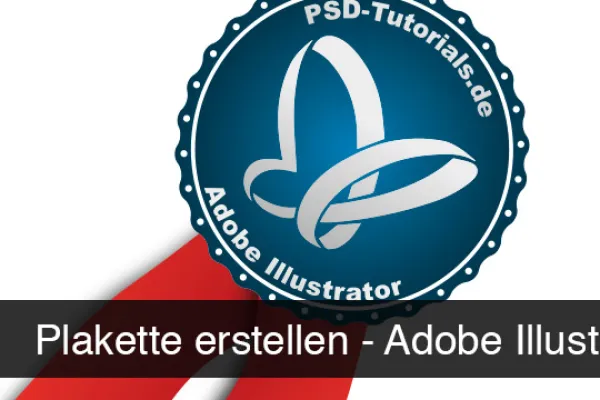
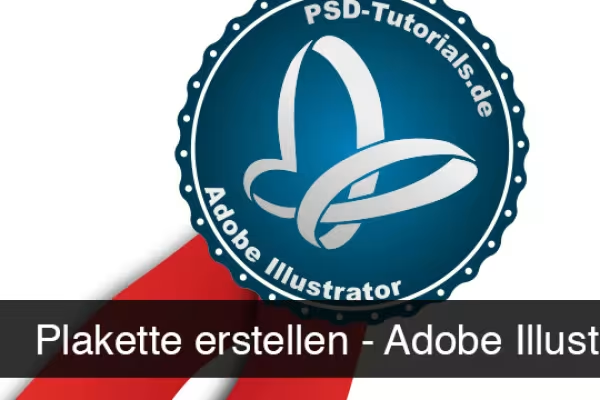
I'm honored that you're back at the start of one of my tutorials. Here we will create such a badge together step by step. You will get in touch with the Pathfinder, the rotate function and some other little tips and tricks around Adobe Illustrator.
In this bonus video, we take a look at how to plot a great sticker using a vector graphic.
In this video you will get an insight into working with "vector smart objects" in Photoshop. It's worth watching. :-)
You can often create much more accurate shapes with Illustrator than with Cinema 4D. In this video you will learn how to export these paths for Cinema 4D.
This is the last video of the great basic training on Adobe Illustrator. Here you will learn how to recolor graphics very quickly.
Another new update for Adobe Illustrator CC has been released - version 2015.3. In this video, Julian Rohm explains the new features of the update. Have fun watching.
Comment now „Adobe Illustrator Introduction: Learn the basics“