
User Experience (UX) & Customer Journey - the practical tutorial

- Avoid frustration and reduce abandonment rates: How to improve the user experience for your visitors
- Everything at a glance: Which factors are decisive along the entire customer journey
- Specific examples: How you should design your buttons, navigation and landing pages, among other things
- Easy to use: You don't need any developer or special software knowledge
- Directly implementable: Check and optimize your own pages with your new UX knowledge
- From the field: Agency head Matthias Petri reports on the lessons learned from dozens of website projects
- Over 3 hours, including a downloadable customer journey map and introductory training on Adobe XD
More sales, better ratings - a good user experience makes all the difference! Sensitize yourself to the topic of UX with this training and increase the success of your own websites.
23 Videos, 223 minutes
Intro to the video training
What you can expect in the video training "User Experience (UX) & Customer Journey"
You can expect an exciting training course on "User Experience (UX) & Customer Journey"
What you can expect in the video training "User Experience (UX) & Customer Journey"
4 min OpenUser Experience and Customer Journey
User Experience & Customer Journey: 01 | What and why User Experience?
The first part explains what user experience is in contrast to usability and why a high user experience is so important for you and your customers.
User Experience & Customer Journey: 02 | Pages Experience as a ranking factor for Google
Google has bundled seven primary factors as Page Experience and elevated them to a new ranking factor for the holistic picture of a website's quality. Here you can find out what they are and how you can measure the value of individual factors (Core Web Vitals) for your website.
User Experience & Customer Journey: 03 | Becoming aware of the customer journey
This tutorial uses examples to make you aware of the importance of the customer journey and sensitize you to the various needs of your customer at the individual stages of their journey to the desired behavior.
User Experience & Customer Journey: 04 | The Customer Journey Map
You will receive the business template "Customer Journey Map" as working material for the training, which you can use to work out your own customer journey. This tutorial provides an example of how to work with it.
User Experience & Customer Journey: 05 | Landing pages and orientation triggers for scrolling
In this tutorial, we will look at the homepage and a subpage as the first in-house touchpoint when your target customer arrives at your website via an external channel. Since landing pages can all be a little longer these days, small orientation triggers for scrolling play a role for you.
User Experience & Customer Journey: 06 | Avoiding unnecessary page changes
The purpose of slide boxes, light boxes and accordion boxes is to spare users unnecessary page changes. Every page change forces the user to reorient themselves, which is why the user flow should be carefully considered.
User Experience & Customer Journey: 07 | Buttons and Call-to-Action
Do your buttons and links only contain the name "Learn more" or "Continue"? Or does the user find out exactly what happens when they click? In this tutorial, we will focus on the design of buttons and the importance of ensuring that the call-to-action to the user is clear and understandable at all times on a website.
User Experience & Customer Journey: 08 | Slideshows and full-page banners (interstitials)
Images that move automatically are easily associated as advertising. And full-page banners can also be misunderstood as advertising pop-ups. In this tutorial, we take a closer look at these two aspects.
User Experience & Customer Journey: 09 | Location icon and telephone number
If your company operates locally and serves local customers who also like to visit your location, both the location icons and the telephone number are important elements for a high user experience.
User Experience & Customer Journey: 10 | Selection of date and period with the date picker
In this tutorial, we look at several live examples of how date selection can work both poorly and well. Especially in this area, a high user experience can prevent a user from abandoning and encourage the desired behavior.
User Experience & Customer Journey: 11 | Navigation, the hamburger menu and responsive logos
Designing navigation according to the user's status helps users to always find exactly what they are looking for and what they are interested in. We will also show you what is important for the hamburger menu for the mobile view and what responsive logos are all about.
User experience & customer journey: 12 menu items in the navigation and micro animations
How should the menu items in a navigation be structured? What is at the front, what further back? How do you enable users to access deeper levels? These topics are covered in this tutorial. You will also be shown small examples of how to add some flair to your website with (micro) animations.
User Experience & Customer Journey: 13 | The search on e-commerce sites
Should a search field be collapsed or expanded from a UX perspective? How do auto-suggestions help the searcher and what does the search have to do with the conversion rate? Find out important facts about search input and how to get the best out of it for you and your e-commerce site.
User Experience & Customer Journey: 14 | The benefit-based promise
Does your website make it clear to your target customer what they will get out of buying or booking with you? In this tutorial, I'll show you a few examples of directly understandable, benefit-based promises to your customer.
User Experience & Customer Journey: 15 | Category and product pages and filter options
Filter options are essential for customers, especially for many products. You also support the user experience with a structure that provides sufficient information even when quickly skimming a product text, as well as satisfying the deeper information needs of your target customers with more detailed information and enlargeable product images, star ratings and reviews.
User Experience & Customer Journey: 16 | The checkout process and form fields
The checkout process is the most sensitive area for online stores because this is where customers tend to abandon their purchases. This tutorial will show you how to create a shopping cart with the best possible user experience. Particular attention is paid to upselling and cross-selling potential, registration processes and form entries.
User Experience & Customer Journey: 17 | Feedback, interaction options and individual customizability
This tutorial will show you how to help your users carry out exactly the interactions they want and avoid unnecessary or even incorrect actions. You can also enhance the user experience for your users with the help of system-side feedback, help and FAQ areas.
User Experience & Customer Journey: 18 | Browser Customization
Browser customization is a small thing, but quite cool and supports branding by allowing mobile browsers to take on the color of your corporate design. Technically, it is very easy to implement. You can find out how to do it in this tutorial.
User Experience & Customer Journey: 19 | Social Proof according to the EAT principle
Google also measures page quality using the EAT principle (Expertise, Authority, Trust). Elements that increase your social proof are helpful here. This tutorial will show you numerous practical examples of how to increase your social proof.
User Experience & Customer Journey: 20 | Show your face according to the EAT principle
One way to build identification with your target customers and at the same time make a positive contribution to site quality in terms of the EAT principle and user experience is to show your face. People like to buy from people. That's exactly what this tutorial is about.
User Experience & Customer Journey: 21 | Bonus additions and reciprocity
In this tutorial, we will look at two methods that can be used to increase the conversion rate. If you also want to make your call-to-action more attractive, you can also rely on bonus additions and the psychological principle of reciprocity to make it easier to (mis)lead your customers to the desired behavior.
User Experience & Customer Journey: 22 | Introduction and overview of working with Adobe XD: Design, Prototyping, Release
In this video, I provide an overview of the possibilities of modern UI software such as Adobe XD. Modern workflows are presented, with which marketing representatives, people who work as an interface between agencies, as well as designers can use the individual sub-areas of a UI/UX value chain for themselves.
This includes insights into the disciplines: Design process, prototyping, customer journey map as well as collaborative work with different teams and people involved.
User Experience & Customer Journey: 02 | Pages Experience as a ranking factor for Google
18 min OpenUser Experience & Customer Journey: 03 | Becoming aware of the customer journey
17 min OpenUser Experience & Customer Journey: 05 | Landing pages and orientation triggers for scrolling
5 min OpenUser Experience & Customer Journey: 08 | Slideshows and full-page banners (interstitials)
7 min OpenUser Experience & Customer Journey: 10 | Selection of date and period with the date picker
8 min OpenUser Experience & Customer Journey: 11 | Navigation, the hamburger menu and responsive logos
8 min OpenUser experience & customer journey: 12 menu items in the navigation and micro animations
7 min OpenUser Experience & Customer Journey: 15 | Category and product pages and filter options
10 min OpenUser Experience & Customer Journey: 17 | Feedback, interaction options and individual customizability
11 min OpenUser Experience & Customer Journey: 19 | Social Proof according to the EAT principle
11 min OpenUser Experience & Customer Journey: 20 | Show your face according to the EAT principle
8 min OpenUser Experience & Customer Journey: 22 | Introduction and overview of working with Adobe XD: Design, Prototyping, Release
26 min OpenExamples of use
-
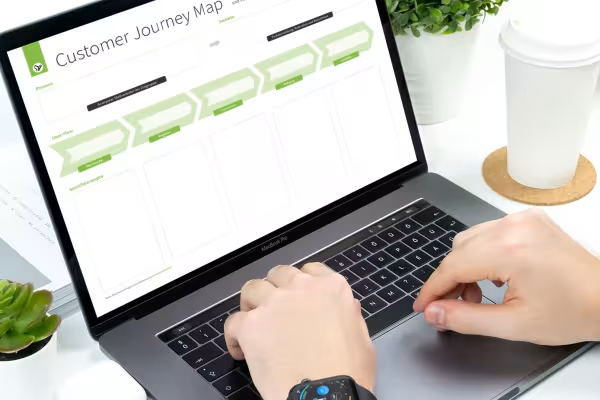 Use the enclosed customer journey map to improve the user experience of your pages.
 -
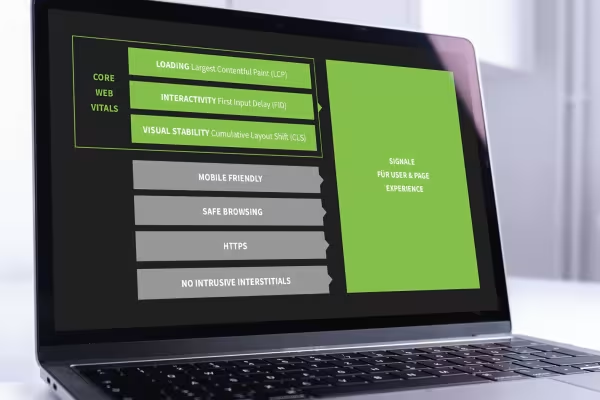 The training provides you with insights into UX theory, always underpinned with concrete practical relevance.
 -
 Telephone number, navigation, orientation triggers: get to know simple ways to improve the user experience.
 -
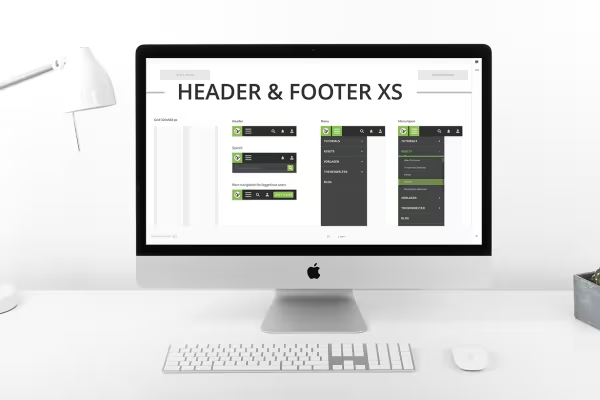 Always in focus with every topic: best practice examples for inspiration!
You might also like

More style, more power, more templates!

Full power, more inspirations, maximum WOW effect!

Live your layout now!

Create, set up & optimize online advertising
Comment now „User Experience (UX) & Customer Journey - the practical tutorial“